Any effort that will result to better management of water resources will always have the Stephen Salony stamp of approval. Follow me on Twitter to learn more about the advocacies that are close to my heart.Water is not just vital to sustain life; it's also a crucial resource for businesses. From food and clothing to cars and mobile phones, water is an essential input. But if you don't know how much you are using or how much is available to use in a given catchment, it's impossible to reduce water use or identify threats to operations from water scarcity.In a recent survey, chief executives and world leaders said they regarded water availability in the top five global risks to business — and with good reason. Water scarcity or pollution incidents can halt production, disrupt the supply chain, lead to conflict with other water users, such as farmers or communities in the area, and harm corporate reputations.It's imperative to get water management right, not just at head office but right along the supply chain. This is no easy task – it's taken a lot of effort and time to get companies to do the equivalent for carbon emissions, and water-use assessment is some way behind, certainly in terms of take up.One method is to apply Water Footprint Network's water footprint assessment methodology – recently launched as a free online tool. This is a four-stage process, which allows the user to set the goal and scope of the assessment, calculate the water footprint (the total volume of freshwater used to produce goods and services), assess its sustainabilityin terms of local water scarcity and pollution levels, and work to reduce the water footprint or improve sustainability. This was the approach theC&A Foundation, with the fashion company C&A, took, recently announcing a three-year partnership with Water Footprint Networkaround sustainable water use.As part of this initiative, C&A wanted to calculate the water footprint for the manufacture of cotton products along its supply chain, and assess its sustainability. It was particularly interested in comparing the levels of harmful pollutants released into the environment – specifically fresh water – from conventional and organic cotton cultivation.
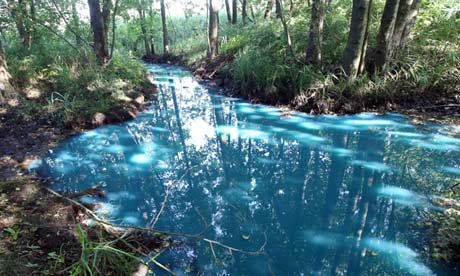
Can water footprinting help companies manage water scarcity and pollution risks? Image Source: www.guim.co.ukBy calculating the water footprint of 480 supplier farms in India, C&A discovered that conventional cotton cultivation has a grey water footprint (the volume of freshwater needed to dilute pollutants to keep water quality at acceptable standards) about five times larger than the organic equivalent, mainly because of the use of chemical pesticides on non-organic farms."These studies have provided us with valuable insights that will help us to further reduce our water footprint along the entire value chain," said Phil Chamberlain, head of sustainable business development and board member of the C&A Foundation last month."We are developing mandatory guidelines, instruments and training for our partners, cotton farmers and factory workers."It's not just the fashion sector that is looking at water use along the supply chain. Tata Group, working with Water Footprint Network andInternational Finance Corporation, recently published a report detailing the results of a joint project to develop its corporate water sustainability framework, promote sustainable water use at the company's 12 plants across India, and contribute to the global knowledge pool about corporate water stewardship.Four Tata Group companies – Tata Steel, Tata Chemicals, Tata Motors and Tata Power – carried out a water footprint assessment. This highlighted a number of areas where the companies should target efforts to improve the sustainability of its water use. For Tata Motors, for example, the assessment showed that its 1,000 suppliers are responsible for a majority of its water footprint, while the highest "inside-the-fence" water consumption is from its paint shop and forging operations.It also showed that Jamshedpur, where Tata Motors has a facility, becomes a water scarcity hotspot from February to May when the River Subarnarekha is at its lowest level – and how much it relies on dammed water to cover the shortages.Tata Motors plans to use this information as a benchmark against which to improve performance. Meanwhile, Tata Group is rolling out the water footprint assessment methodology for other companies in the group."We looked closely at the water footprint both in the operations and along the supply in the context of the local water scarcity and water pollution to help identify where the company's water footprint was contributing to local water stress," says Ruth Mathews, executive director of Water Footprint Network."In fact, in some facilities, this was the first time that Tata managers had looked at their company's water use in relation to the local catchment and it helped them expand beyond a purely operations viewpoint to understanding their water use within the context of local water issues."Of course, this is just the start of managing water use. As David Zetland, senior water economist and author of The End of Abundance, says: "The challenge then is how to limit risk from water scarcity and how to reform water use for everyone in the catchment."That though is for another article. In the meantime, the fact that some companies are starting out on the long journey to improve the sustainability of their water footprints will hopefully inspire others to do the same. As Mathews says: "The time for talking about the threat of water scarcity and poor water quality is over; now we need to act."
Tuesday, September 17, 2013
REPOST: Water footprinting: Will it help companies manage a scarce resource?
The Guardian’s Flemmich Webb notes that companies should embrace the idea of water footprinting to understand their water use. However, will the complexities of the methodology be too much to handle for some corporations? Find out from the article below.

Sunday, September 1, 2013
REPOST: New leaks into Pacific at Japan nuclear plant
 |
Members of a Fukushima panel inspecting the construction of a barrier that is meant to stop contaminated water from leaking.
Image source: NYTimes.com
|
Environmentalists are generally very uncomfortable with and wary about nuclear power, especially the fatal consequences of fallouts. Martin Fackler of the New York Times writes about water contaminated with nuclear waste seeping into the ocean from Japan’s damaged Fukushima power plant. Read the full article here.
TOKYO — Tons of contaminated groundwater from the stricken Fukushima nuclear plant have overwhelmed an underground barrier and are emptying daily into the Pacific, creating what a top regulator has called a crisis.
The water contains strontium and cesium, as well as tritium, which is considered less dangerous when released into the ocean. Despite increasing alarm among regulators in recent weeks, the plant’s operator says it does not yet pose a health threat because levels of the contaminants are still very low in the open ocean, beyond the plant’s man-made harbor — a contention even critics support.
But regulators and critics alike are worried because the company, the Tokyo Electric Power Company, or Tepco, has been unable to stop the flow of the contaminated water, which appears to have started between December and May. The company has also not yet conclusively identified the source of the contamination, compounding fears.
“Tepco lacks a sufficient sense of urgency for this crisis,” Shinji Kinjo, a high-level official at the country’s nuclear regulatory watchdog, said Tuesday in an interview.
The plant was already struggling to store hundreds of thousands of tons of contaminated water that flowed through the buildings housing three reactors where meltdowns occurred in 2011. But the contamination in this new groundwater problem is from different sources, Tepco said.
The releases of information in recent days on the latest problem followed a familiar pattern, with the company providing very technical data in bits and pieces without context, making it difficult to judge its significance.
Tepco had said that the groundwater, which flows downhill from mountains behind the plant and into the sea, had remained relatively clean even after the accident because it is so deep, several yards below the surface. But in May the company reported detecting a sharp increase in the amounts of radioactive tritium in groundwater beneath the plant.
Tepco now says the groundwater is emptying into the plant’s man-made harbor at a rate of 400 tons a day — enough to fill an Olympic swimming pool every week. While the company did not specifically say how much of the water was contaminated, it offered a calculation for the amount of tritium being released that assumed all of the water was contaminated.
To halt the flow of contaminated water, Tepco built an underground barrier along the shoreline in front of one damaged reactor in June by injecting chemicals into the soil to harden it. But the operator has told regulators that it believes the barrier failed to stop the water, instead acting as a dam that pooled the contaminated underground water behind it until it flowed over the top of the barrier toward the sea. Mr. Kinjo, the regulator, warned that if the water kept rising, it could soon come to the surface, increasing hazards for the plant’s already hard-pressed workers.
The company has admitted that it failed to respond quickly enough to the latest groundwater contamination, saying it was preoccupied with more pressing issues like cooling the damaged reactors.
“Tepco appears overwhelmed in dealing with what is a very serious problem,” said Akio Yamamoto, a professor of nuclear engineering at Nagoya University, who serves as outside expert for the Nuclear Regulation Authority, Japan’s nuclear watchdog. “It cannot do everything on its own.”Mr. Yamamoto and other experts agree with Tepco’s assessment that the amounts of radioactive material released into the Pacific have been too small to pose a risk to human health. Still, some critics contend that the plant has emitted far more radioactive materials than it is saying, based in part on levels of contaminants discovered in the harbor, which are well above safe levels in some places.
Regulators said they were waiting for Tepco to take additional steps to slow the flow of contaminated groundwater into the sea. These include construction of more chemical barriers as well as pumping out about 100 tons per day of the water to keep it from overflowing the barriers. This, however, will create a new problem, as the water must then be stored on the grounds of a plant that is already crowded with more than 1,000 large tanks filled with contaminated water siphoned from the reactor buildings.
If there's something strange in the water and it can't possibly be good, you can bet that Stephen Salony will be all over it. For more of my flotsam about water quality and other things, follow me on Twitter.
Subscribe to:
Posts (Atom)