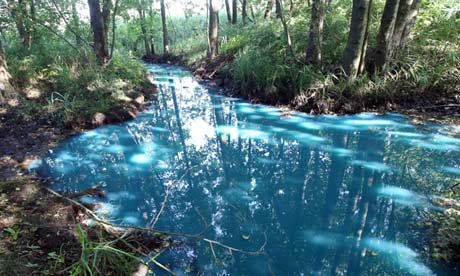
I'm Stephen Salony, environmentalist and water quality expert. Visit this Facebook page for more links to articles about the clean water supplies.It hasn’t been a great few weeks for water. Not long ago, I wrote about the trace amounts of medications found in drinking water supplies around the country. Not long after, a chemical spill in West Virginia led to a water ban for 300,000 people in the state, sickening hundreds of residents and leaving countless more wary of using their tap water.
Image Source: www.foxnews.com
The latest water woes focus on New York City, home to no less than 8.3 million people. A recent investigation by The New York Timesrevealed that the water towers sitting atop tens of thousands of buildings around the city - providing tenants with the water they use for drinking, bathing, cooking, and more - are laden with bacteria like E. coli and coliform. Their analysis found these microbes even in towers that are well-maintained; that is, if a building's owner bothers to maintain its water tower at all. According to the Times, the New York City Department of Health and Mental Hygiene does not routinely enforce the regulations governing water tank cleaning and inspection.
The contents of the Times report goes from bad to worse to run for the hills. As they note, E. coli is a microbe carried in the feces of mammals and birds, which almost certainly means birds, squirrels, and other animals are invading city water towers. When a tower’s holes are actually discovered and plugged, the epoxy commonly used to caulk them, called Sea Goin’ Poxy Putty, is not approved for use in drinking water, and is made with bisphenol-A (BPA). As a reminder, BPA is a toxic chemical found in many food and beverage containers. It has been linked to childhood obesity, heart disease, prostate and breast cancer, asthma, headaches and more.
Naturally, officials insist drinking water in New York City is safe, because otherwise there would be a large outbreak of illness that could be directly traced to a particular building’s water supply. But, as the Times notes, with 60 percent of building owners failing to comply with water tank inspection and testing requirements most tenants would have a hard time proving a connection between illness and poor water quality in the first place.
As with so many other issues, water safety appears to be held captive by bureaucracy. A 2009 attempt to require the New York City health department to track water tank inspections through a database was deemed “unnecessary” and “too expensive,” according to the Times. You know what’s also expensive? Providing health care to people who become sick after being exposed to E.coli and other bacteria. And nothing is more necessary to human existence than water – its availability, purity, and safe delivery to anyone who wants it, at any time, for any reason.
The United States Congress passed The Safe Drinking Water Act in 1974 in an attempt to protect public health by regulating the nation’s public drinking water supply. The problem, at least in the case of New York City, is that once the water leaves well-protected reservoirs upstate, it is no longer under the purview of the federal – or even the state – government. As the water crosses city lines, it is up to building owners to make sure their towers are cleaned, inspected and tested annually. Unfortunately, lax enforcement of such regulations by local authorities provides little impetus for building owners or superintendents to adhere to standards, strict or not.
In the New York Times article, a city health official claims there is no evidence that neglecting a building’s water tank could have negative health consequences. But there is plenty of evidence that exposure to E. coli causes severe abdominal cramps, bloody diarrhea, and vomiting, as The Mayo Clinic notes on its website. Other health problems that can result from drinking contaminated water include reproductive problems, neurological disorders, and gastrointestinal illnesses like salmonella and Hepatitis A, according to the U.S. Centers for Disease Control and Prevention. The very young and very old are particularly vulnerable to such health problems.
Aside from boiling water before each use, there are some steps you can take to protect yourself from impure water, no matter where you live. A home water filtration system can help, and the CDC lists on its website the various filter choices, and how each affects the water it treats. EWG’s water filter buying guide is also helpful.
Find out the condition of the water where you live by visiting the EPA’s website. If you don’t like what you see, or suspect a problem in your home or apartment building, contact your local health department, and then contact elected officials. Let as many people as possible know you’re unhappy with the system that is delivering you this most vital of elements.
Saturday, February 22, 2014
REPOST: How clean is your city's drinking water?
With more than 8.3 million residents, New York is just one of the cities experiencing unclean water supplies. Read this article from Fox News for more about the issue.


Sunday, January 19, 2014
REPOST: Water Stress to Affect 52% of World’s Population by 2050
A new MIT study suggests that 5 billion (52%) of the world's population would live in water stressed regions by 2050. This article discusses the growing water scarcity and its impact to agriculture, energy, tourism, and the industrial sector.
Hello, Stephen Salony, here. I'm a cyclist and a strong supporter of clean water advocacies. Get to know me more through this Facebook page.
Image Source: ecoficial.com

Some 52 percent of the world’s projected 9.7 billion people will live in water-stressed regions by 2050, MIT researchers say.
The researchers used the MIT Integrated Global System Model Water Resource System (IGSM-WRS) to evaluate water resources and needs worldwide. The modeling tool also allowed researchers to measure how climate change and socioeconomics affect water stress.
Image Source: utilities-me.com

The study found population and economic growth are the socioeconomic factors most responsible for increased water stress, resulting in an additional 1.8 billion people living in water-stressed areas. Of these additional people, 80 percent will live in developing countries.
Climate change, on the other hand, will have a bigger affect on water availability in developed nations, the study says.
Thirty-seven countries face “extremely high” levels of water stress, using more than 80 percent of their available water supply every year, according to the World Resources Institute’s water stress rankings published last month.
Image Source: un.org

This means that more than 80 percent of the water available to agricultural, domestic and industrial users is withdrawn annually, which can hurt businesses, farms and communities, according to a WRI blog. As an example, the blog cites recent droughts, which threatened GDP growth in the US.
Hello, Stephen Salony, here. I'm a cyclist and a strong supporter of clean water advocacies. Get to know me more through this Facebook page.
Monday, December 16, 2013
REPOST: Olympic sailors upset by water pollution in Rio de Janeiro
Water pollution can ruin the view of a beautiful city for anyone, as the Olympic sailors found out upon visiting the waters of Rio de Janeiro. The Associated Press reports.
RIO DE JANEIRO — Olympic sailors on Saturday checked out the venue for the 2016 Games in Rio de Janeiro.
Many didn’t like what they saw.
“I’ve been sailing all over the world for 20 years now, and this is the most polluted place I’ve ever been,” said Allan Norregaard, a Danish bronze medalist in the 2012 London Olympics. “It’s really a shame because it’s a beautiful area and city, but the water is so polluted, so dirty and full of garbage.”
Rio’s local Olympic organizing committee has promised the pollution will be cleaned up when the Olympics open in 2 1/2 years. Government officials have pledged to reduce 80 percent of the pollution flowing into the bay.
But the sailors doubt the problem can be fixed after festering for decades, and many worry about their health. Environmentalists call measures being taken “stopgap,” likely to mask the problem and not cure it.
The Associated Press has documented over the last several weeks that nearly 70 percent of Rio’s waste goes untreated into surrounding waters. Famous beaches like Copacabana and Ipanema are dirty. Untreated sewage pours into a lagoon bordering the Olympic Park, the heart of the games.
Norregaard said that while sailing the last few days he’d seen entire trees floating in the bay, doors, chunks of timber with nails protruding, swollen mattresses and endless plastic bags.
Another sailor talked about a horse carcass in the 148-square-mile bay, which opens into the Atlantic just above Rio’s famed Copacabana beach.
The Dane said the floating debris makes racing unfair and dangerous. The other issue is the health risk with high levels of fecal coliform bacteria in the water.
“I would definitely not swim in it,” Norregaard said. “We have had a couple of incidents where people went in the water and came up with red dots on their body. I don’t know what’s in the water, but it’s definitely not healthy.”
Brazilian sailor Martine Soffiatti Grael grew up on the bay. Her father, Torben Grael, is a five-time Olympic medalist, two of them gold.
“For me since I was a child, it has only gotten worse,” said the 22-year-old, who hopes to qualify for the Rio Games. “The government says it has lots of programs to clean the bay, but I haven’t seen any progress being made.”
Thomas Bach, the new president of the International Olympic Committee, is scheduled to be in Rio early next year to monitor progress. The IOC is concerned about delays in organizing and building venues, and pollution is another worry with costs for the games put at $15 billion — a mix of public and private money.
“Of course, the water will not be clean as sailing in the Caribbean,” Brazilian Robert Scheidt, who has won five Olympic medals, said by phone to the AP. “I have never swum in there (Guanabara). ... Inside the bay I know it’s not the proper place to swim. I’ve sailed there and never got any disease.”
Ian Barker, who won a silver medal for Britain in the 2000 Olympics and now coaches Ireland, said he’s sailed in 35 countries, and this is the worst. He said sailors in training have had to stop to disentangle their rudders from rubbish.
“It’s a sewer,” he said. “It’s absolutely disgusting. Something has to be done about it. But you need the political will for these things to happen and at the moment it’s not there.”
I'm Stephen Salony, water quality expert, environmentalist, and cyclist. Follow me on Twitter for more updates like this.
 |
| Image source: weather.com |
RIO DE JANEIRO — Olympic sailors on Saturday checked out the venue for the 2016 Games in Rio de Janeiro.
Many didn’t like what they saw.
“I’ve been sailing all over the world for 20 years now, and this is the most polluted place I’ve ever been,” said Allan Norregaard, a Danish bronze medalist in the 2012 London Olympics. “It’s really a shame because it’s a beautiful area and city, but the water is so polluted, so dirty and full of garbage.”
Rio’s local Olympic organizing committee has promised the pollution will be cleaned up when the Olympics open in 2 1/2 years. Government officials have pledged to reduce 80 percent of the pollution flowing into the bay.
But the sailors doubt the problem can be fixed after festering for decades, and many worry about their health. Environmentalists call measures being taken “stopgap,” likely to mask the problem and not cure it.
 |
| Image source: weather.com |
The Associated Press has documented over the last several weeks that nearly 70 percent of Rio’s waste goes untreated into surrounding waters. Famous beaches like Copacabana and Ipanema are dirty. Untreated sewage pours into a lagoon bordering the Olympic Park, the heart of the games.
Norregaard said that while sailing the last few days he’d seen entire trees floating in the bay, doors, chunks of timber with nails protruding, swollen mattresses and endless plastic bags.
Another sailor talked about a horse carcass in the 148-square-mile bay, which opens into the Atlantic just above Rio’s famed Copacabana beach.
The Dane said the floating debris makes racing unfair and dangerous. The other issue is the health risk with high levels of fecal coliform bacteria in the water.
“I would definitely not swim in it,” Norregaard said. “We have had a couple of incidents where people went in the water and came up with red dots on their body. I don’t know what’s in the water, but it’s definitely not healthy.”
Brazilian sailor Martine Soffiatti Grael grew up on the bay. Her father, Torben Grael, is a five-time Olympic medalist, two of them gold.
 |
| Image source: weather.com |
“For me since I was a child, it has only gotten worse,” said the 22-year-old, who hopes to qualify for the Rio Games. “The government says it has lots of programs to clean the bay, but I haven’t seen any progress being made.”
Thomas Bach, the new president of the International Olympic Committee, is scheduled to be in Rio early next year to monitor progress. The IOC is concerned about delays in organizing and building venues, and pollution is another worry with costs for the games put at $15 billion — a mix of public and private money.
“Of course, the water will not be clean as sailing in the Caribbean,” Brazilian Robert Scheidt, who has won five Olympic medals, said by phone to the AP. “I have never swum in there (Guanabara). ... Inside the bay I know it’s not the proper place to swim. I’ve sailed there and never got any disease.”
Ian Barker, who won a silver medal for Britain in the 2000 Olympics and now coaches Ireland, said he’s sailed in 35 countries, and this is the worst. He said sailors in training have had to stop to disentangle their rudders from rubbish.
“It’s a sewer,” he said. “It’s absolutely disgusting. Something has to be done about it. But you need the political will for these things to happen and at the moment it’s not there.”
I'm Stephen Salony, water quality expert, environmentalist, and cyclist. Follow me on Twitter for more updates like this.
Tuesday, November 19, 2013
REPOST: Rab Wardell wheeling for Glasgow mountain bike spot in 2014
In an outdoor activity where craggy terrain, unpredictable weather, and bedrock trails always pose a threat, true passion toward cycling is difficult to come by. Mountain cyclist Rab Wardell makes this sport a part of his lifestyle, even considering it as a sub-discipline of his personal culture.
The Stephen Salony character trademark encompasses deep appreciation toward sports and serious care for the environment. Visit my Twitter page to know more about me.
Image source: bbc.co.uk
Spending time with Rab Wardell allows you to see just how much he loves cycling.
One might expect nothing less of a professional rider, but his concern for the participation levels in his chosen sport goes beyond, one suspects, that of, say, the well-paid footballer or the pampered golfer.
Although purportedly taking an end-of-season break, the Glasgow-based Fifer is raving about the interest he witnessed in the track league at the velodrome, which can be seen from the Cathkin Braes mountain bike course on the south side of Glasgow where he greets have-a-go riders with genuine warmth.
Some are pensioners, others are schoolchildren on an activity break; all are welcomed by a rider hoping to race there at next year's Commonwealth Games.
He is pleased to see people using the course he had a hand in designing.
While working as a coach at Scottish Cycling, Wardell was used as a consultant on the course's lay-out, or "allowed to give my opinion on it", as the 28-year-old modestly puts it.
He has the Games and finding a new team for 2014 on his mind, but he is as happy to talk about cycling facilities in his adopted home city.
"I think it's perfect for the Games and it's a brilliant legacy for the people of Glasgow to use," he says of the mountain bike course, which, like many Games venues, is already available for the public to use.
Mountain biking and cross-country cycling are Wardell's disciplines, but he took to the asphalt in the summer for the British Road Race Championships in Glasgow.
He was never likely to threaten eventual winner Mark Cavendish in a charge to the finish line but he did manage to thrill the crowds nonetheless - by doing a wheelie up Montrose Street, a sickeningly steep city centre climb.
"A few people liked that," he says with a smile. "I'd much rather have been having a good result but at least I could do something to get a cheer!"
Wardell has been riding for Trek in recent years but that deal ends in December.
"Fingers crossed I'll have something in place before Christmas and then I can focus on training and racing again," he says. "I'd like to think that I can offer something."
Certainly, his CV suggests that he can.
Wardell represented Scotland at the Melbourne Commonwealth Games in 2006, though did not finish the race, and is vying for a 2014 place (there was no mountain bike event at the Delhi Games).
He is the current Scottish Cyclo-Cross champion, finished 11th in the British Mountain Bike Championships this year and in recent months has been competing in China, Malaysia and Brazil.
Next month, he and his fellow Commonwealth mountain bike hopefuls head to Spain with road racers such as David Millar, Andy Fenn, James McCallum and Evan Oliphant as part of a Scotland warm-weather training camp.
"It's the first real big block of training for me going into next year and it will be useful to ride with such experienced riders," says Wardell.
"I'm looking to race quite a heavy programme early season to gain the qualification standards and make sure I earn my place.
"There's really tough competition, with six or seven riders going for three places. It's going to be tough but we'll have a great team for Scotland."
Team GB riders Grant Ferguson - "a huge talent" - and Kenta Gallagher, his good friend Gareth Montgomerie (13th in Melbourne) and brothers Hamish and Sebastian Batchelor provide stern opposition for a Games place.
He is conscious, too, of the challenge by young Ben Wyvis Cycle Club riders Iain Paton and Tom Evans.
He describes his recent globe-trotting as "a really good way to finish the season, with some good results" (he finished just outside the top 10 in China, Malaysia and Brazil).
At the Chinese Guiyang International Mountain Bike Invitational, a short track event was followed by Olympic cross-country racing, which also featured in the stages in the six-day Langkawi International Mountain Bike Challenge and the week-long race in South America.
The longest stage in the latter was won in almost six hours of cycling, but the Commonwealth Games ride will be shorter at about 90-100 minutes.
"The race in 2014 will be really fast and exciting," he suggests.
"With this track there is certainly an element of tactics.
"It's almost like a road race when you're competing on it. At the British National Championships there was group racing; there weren't riders on their own able to ride away.
"You have to really time your efforts. Any mistake costs you a lot. If you crash and lose 10 seconds, it's really difficult to close that gap again.
"You need to be consistent, skilful and fit because the pace is going to be incredible; you need to be a good all-rounder."
Wardell envisages a group of 10-15 riders forming from the mass start as they tackle the opening loop.
He adds: "There's maybe only a minute-and-a-half of riding before it filters down into single track. If you're far back at that point you've got your work cut out.
"The start is always exciting in a mountain bike race."
The thrill of racing is undiminished for Wardell. Just like those mountain bikers jostling for position in the opening burst, he must hope he times his run in 2014 to perfection.

The Stephen Salony character trademark encompasses deep appreciation toward sports and serious care for the environment. Visit my Twitter page to know more about me.
Tuesday, September 17, 2013
REPOST: Water footprinting: Will it help companies manage a scarce resource?
The Guardian’s Flemmich Webb notes that companies should embrace the idea of water footprinting to understand their water use. However, will the complexities of the methodology be too much to handle for some corporations? Find out from the article below.
Any effort that will result to better management of water resources will always have the Stephen Salony stamp of approval. Follow me on Twitter to learn more about the advocacies that are close to my heart.Water is not just vital to sustain life; it's also a crucial resource for businesses. From food and clothing to cars and mobile phones, water is an essential input. But if you don't know how much you are using or how much is available to use in a given catchment, it's impossible to reduce water use or identify threats to operations from water scarcity.In a recent survey, chief executives and world leaders said they regarded water availability in the top five global risks to business — and with good reason. Water scarcity or pollution incidents can halt production, disrupt the supply chain, lead to conflict with other water users, such as farmers or communities in the area, and harm corporate reputations.It's imperative to get water management right, not just at head office but right along the supply chain. This is no easy task – it's taken a lot of effort and time to get companies to do the equivalent for carbon emissions, and water-use assessment is some way behind, certainly in terms of take up.One method is to apply Water Footprint Network's water footprint assessment methodology – recently launched as a free online tool. This is a four-stage process, which allows the user to set the goal and scope of the assessment, calculate the water footprint (the total volume of freshwater used to produce goods and services), assess its sustainabilityin terms of local water scarcity and pollution levels, and work to reduce the water footprint or improve sustainability. This was the approach theC&A Foundation, with the fashion company C&A, took, recently announcing a three-year partnership with Water Footprint Networkaround sustainable water use.As part of this initiative, C&A wanted to calculate the water footprint for the manufacture of cotton products along its supply chain, and assess its sustainability. It was particularly interested in comparing the levels of harmful pollutants released into the environment – specifically fresh water – from conventional and organic cotton cultivation.
Can water footprinting help companies manage water scarcity and pollution risks? Image Source: www.guim.co.ukBy calculating the water footprint of 480 supplier farms in India, C&A discovered that conventional cotton cultivation has a grey water footprint (the volume of freshwater needed to dilute pollutants to keep water quality at acceptable standards) about five times larger than the organic equivalent, mainly because of the use of chemical pesticides on non-organic farms."These studies have provided us with valuable insights that will help us to further reduce our water footprint along the entire value chain," said Phil Chamberlain, head of sustainable business development and board member of the C&A Foundation last month."We are developing mandatory guidelines, instruments and training for our partners, cotton farmers and factory workers."It's not just the fashion sector that is looking at water use along the supply chain. Tata Group, working with Water Footprint Network andInternational Finance Corporation, recently published a report detailing the results of a joint project to develop its corporate water sustainability framework, promote sustainable water use at the company's 12 plants across India, and contribute to the global knowledge pool about corporate water stewardship.Four Tata Group companies – Tata Steel, Tata Chemicals, Tata Motors and Tata Power – carried out a water footprint assessment. This highlighted a number of areas where the companies should target efforts to improve the sustainability of its water use. For Tata Motors, for example, the assessment showed that its 1,000 suppliers are responsible for a majority of its water footprint, while the highest "inside-the-fence" water consumption is from its paint shop and forging operations.It also showed that Jamshedpur, where Tata Motors has a facility, becomes a water scarcity hotspot from February to May when the River Subarnarekha is at its lowest level – and how much it relies on dammed water to cover the shortages.Tata Motors plans to use this information as a benchmark against which to improve performance. Meanwhile, Tata Group is rolling out the water footprint assessment methodology for other companies in the group."We looked closely at the water footprint both in the operations and along the supply in the context of the local water scarcity and water pollution to help identify where the company's water footprint was contributing to local water stress," says Ruth Mathews, executive director of Water Footprint Network."In fact, in some facilities, this was the first time that Tata managers had looked at their company's water use in relation to the local catchment and it helped them expand beyond a purely operations viewpoint to understanding their water use within the context of local water issues."Of course, this is just the start of managing water use. As David Zetland, senior water economist and author of The End of Abundance, says: "The challenge then is how to limit risk from water scarcity and how to reform water use for everyone in the catchment."That though is for another article. In the meantime, the fact that some companies are starting out on the long journey to improve the sustainability of their water footprints will hopefully inspire others to do the same. As Mathews says: "The time for talking about the threat of water scarcity and poor water quality is over; now we need to act."


Sunday, September 1, 2013
REPOST: New leaks into Pacific at Japan nuclear plant
 |
Members of a Fukushima panel inspecting the construction of a barrier that is meant to stop contaminated water from leaking.
Image source: NYTimes.com
|
Environmentalists are generally very uncomfortable with and wary about nuclear power, especially the fatal consequences of fallouts. Martin Fackler of the New York Times writes about water contaminated with nuclear waste seeping into the ocean from Japan’s damaged Fukushima power plant. Read the full article here.
TOKYO — Tons of contaminated groundwater from the stricken Fukushima nuclear plant have overwhelmed an underground barrier and are emptying daily into the Pacific, creating what a top regulator has called a crisis.
The water contains strontium and cesium, as well as tritium, which is considered less dangerous when released into the ocean. Despite increasing alarm among regulators in recent weeks, the plant’s operator says it does not yet pose a health threat because levels of the contaminants are still very low in the open ocean, beyond the plant’s man-made harbor — a contention even critics support.
But regulators and critics alike are worried because the company, the Tokyo Electric Power Company, or Tepco, has been unable to stop the flow of the contaminated water, which appears to have started between December and May. The company has also not yet conclusively identified the source of the contamination, compounding fears.
“Tepco lacks a sufficient sense of urgency for this crisis,” Shinji Kinjo, a high-level official at the country’s nuclear regulatory watchdog, said Tuesday in an interview.
The plant was already struggling to store hundreds of thousands of tons of contaminated water that flowed through the buildings housing three reactors where meltdowns occurred in 2011. But the contamination in this new groundwater problem is from different sources, Tepco said.
The releases of information in recent days on the latest problem followed a familiar pattern, with the company providing very technical data in bits and pieces without context, making it difficult to judge its significance.
Tepco had said that the groundwater, which flows downhill from mountains behind the plant and into the sea, had remained relatively clean even after the accident because it is so deep, several yards below the surface. But in May the company reported detecting a sharp increase in the amounts of radioactive tritium in groundwater beneath the plant.
Tepco now says the groundwater is emptying into the plant’s man-made harbor at a rate of 400 tons a day — enough to fill an Olympic swimming pool every week. While the company did not specifically say how much of the water was contaminated, it offered a calculation for the amount of tritium being released that assumed all of the water was contaminated.
To halt the flow of contaminated water, Tepco built an underground barrier along the shoreline in front of one damaged reactor in June by injecting chemicals into the soil to harden it. But the operator has told regulators that it believes the barrier failed to stop the water, instead acting as a dam that pooled the contaminated underground water behind it until it flowed over the top of the barrier toward the sea. Mr. Kinjo, the regulator, warned that if the water kept rising, it could soon come to the surface, increasing hazards for the plant’s already hard-pressed workers.
The company has admitted that it failed to respond quickly enough to the latest groundwater contamination, saying it was preoccupied with more pressing issues like cooling the damaged reactors.
“Tepco appears overwhelmed in dealing with what is a very serious problem,” said Akio Yamamoto, a professor of nuclear engineering at Nagoya University, who serves as outside expert for the Nuclear Regulation Authority, Japan’s nuclear watchdog. “It cannot do everything on its own.”Mr. Yamamoto and other experts agree with Tepco’s assessment that the amounts of radioactive material released into the Pacific have been too small to pose a risk to human health. Still, some critics contend that the plant has emitted far more radioactive materials than it is saying, based in part on levels of contaminants discovered in the harbor, which are well above safe levels in some places.
Regulators said they were waiting for Tepco to take additional steps to slow the flow of contaminated groundwater into the sea. These include construction of more chemical barriers as well as pumping out about 100 tons per day of the water to keep it from overflowing the barriers. This, however, will create a new problem, as the water must then be stored on the grounds of a plant that is already crowded with more than 1,000 large tanks filled with contaminated water siphoned from the reactor buildings.
If there's something strange in the water and it can't possibly be good, you can bet that Stephen Salony will be all over it. For more of my flotsam about water quality and other things, follow me on Twitter.
Wednesday, July 17, 2013
REPOST: Earth Daze: What Happened to the Environmental Movement?
Time Magazine’s Bryan Walsh examines how Earth Day—and by extension, the environmental movement—may have lost its thunder at present.
It’s Earth Day, though you could be forgiven if you missed it. The annual event doesn’t quite have the same energy as it once did — especially not compared with the first Earth Day 43 years ago. That nationwide event, initially inspired by the work of Wisconsin Senator Gaylord Nelson, was celebrated by more than 20 million people in more than 12,000 events around the country. As Nicholas Lemann pointed out in a recent piece in the New Yorker, Congress took the day off, and two-thirds of its members — Democrat and Republican alike — spoke at Earth Day events. The Today show devoted 10 hours of airtime to Earth Day. And that mobilization — which was decentralized, mostly achieved through a tiny national office — paved the way for real government action: the Clean Air Act of 1970, the Clean Water Act of 1972, the Endangered Species Act of 1973 and the creation of the Environmental Protection Agency (EPA).
This year’s Earth Day was a little less memorable, and a whole lot less bipartisan. (I can’t imagine a Republican member of Congress giving a speech during Earth Day now unless they were calling for the dismantling of the EPA.) And it comes during a moment of crisis for the environmental movement as it attempts to grapple, so far unsuccessfully, with the existential threat of climate change. Back to Lemann:
Forty-three years after the first Earth Day, are Lemann and other critics of the modern environmental movement right? Have greens lost their way — and if so, why?
There’s no getting around the fact that environmentalists have failed to push through a legislative solution to climate change. Cap and trade, even under a Democratic Congress and President, failed in 2010. The international climate regime under the U.N. seems to get closer to collapse every year, and even in much greener Europe, carbon markets simply aren’t working. And environmentalism as a concept doesn’t seem to resonate with Americans as it once did. A new YouGov/HuffPost poll found that Americans are less concerned about the environment now than they were on the first Earth Day. While isolated issues like fracking and the Keystone pipeline resonate strongly with some Americans, especially those who are directly affected — witness the mobbed hearing on the proposed Keystone XL pipeline last week and the stream of antifracking protests — there’s nothing close to the sheer number of Americans who were motivated to take part in the first Earth Day.
What’s changed? You can blame the specific failure of cap-and-trade legislation in part on the mechanics of the U.S. Senate — the bill passed the House, barely — where rural conservative states get outsize representation and where legislation now needs to get 60 votes to pass. (Though of course health care reform still managed to pass despite those same obstacles.) The growing political polarization that has made environmentalism almost solely a Democratic cause can’t be blamed only on greens. But I think the biggest reason is that environmentalism has been a victim of its own success. The environment — everyone’s environment — really was a mess in 1970. Urban rivers were on fire, smog choked the Los Angeles basin, toxic waste affected towns like Love Canal and shorelines were marred by industrial runoff. See this Slate roundup of once polluted or threatened sites in America that have been saved by the environmental movement over the past four decades. Things used to be very, very bad.
And now? The air and water in most of America is much cleaner than it was during the first Earth Day. We have an Environmental Protection Agency to, well, protect the environment, even if it can’t always do the job. The most immediate threats have retreated, and as Michael Kazin points out in the New Republic, that fact alone has hurt environmentalism as an active and broad-based political cause:
That rings true to me. Environmentalists still have success when the issues they take on are direct and local — see the furor over fracking, or the growth of organic food and BPA-free materials. But no matter what the scientific papers and headlines say, climate change still feels distant to most Americans — important, but still distant. One-off events like Superstorm Sandy can and do move the needle — but not enough, yet, to make climate change a front-and-center issue for most Americans. We’re pretty good at paying attention to the here and now, and really bad at planning for the future — half of us aren’t even saving for our own retirement. Building a nationwide coalition around a problem of the future is like trying to grasp fog.
So maybe we should stop comparisons with the first Earth Day. We may never see 20 million Americans demonstrate over the environment — unless, I suppose, things get much, much worse. And there’s great progress that has been made outside traditional movement politics — look at the way businesses large and small have embraced sustainability in a manner that would have been unimaginable some 40 years ago. But it’s going to take more than that, and it will take more than just greens. Climate change is too big — and too important — to be left to the environmentalists alone.
That’s not a pretty picture, but it’s also not an all too hopeless one. Stephen Salony here, bike enthusiast, water quality nerd, and environmentalist. Follow my Twitter for more of my updates.
It’s Earth Day, though you could be forgiven if you missed it. The annual event doesn’t quite have the same energy as it once did — especially not compared with the first Earth Day 43 years ago. That nationwide event, initially inspired by the work of Wisconsin Senator Gaylord Nelson, was celebrated by more than 20 million people in more than 12,000 events around the country. As Nicholas Lemann pointed out in a recent piece in the New Yorker, Congress took the day off, and two-thirds of its members — Democrat and Republican alike — spoke at Earth Day events. The Today show devoted 10 hours of airtime to Earth Day. And that mobilization — which was decentralized, mostly achieved through a tiny national office — paved the way for real government action: the Clean Air Act of 1970, the Clean Water Act of 1972, the Endangered Species Act of 1973 and the creation of the Environmental Protection Agency (EPA).
 | |
| A poster from the first Earth Day in 1970. Image source: Getty Images | . Available from Time.com. |

This year’s Earth Day was a little less memorable, and a whole lot less bipartisan. (I can’t imagine a Republican member of Congress giving a speech during Earth Day now unless they were calling for the dismantling of the EPA.) And it comes during a moment of crisis for the environmental movement as it attempts to grapple, so far unsuccessfully, with the existential threat of climate change. Back to Lemann:
Then, 40 years after Earth Day, in the summer of 2010, the environmental movement suffered a humiliating defeat as unexpected as the success of Earth Day had been. The Senate Majority Leader, Harry Reid, announced that he would not bring to a vote a bill meant to address the greatest environmental problem of our time — global warming. The movement had poured years of effort into the bill, which involved a complicated system for limiting carbon emissions. Now it was dead, and there has been no significant environmental legislation since. Indeed, one could argue that there has been no major environmental legislation since 1990, when President George H.W. Bush signed a bill aimed at reducing acid rain. Today’s environmental movement is vastly bigger, richer and better connected than it was in 1970. It’s also vastly less successful. What went wrong?
Forty-three years after the first Earth Day, are Lemann and other critics of the modern environmental movement right? Have greens lost their way — and if so, why?
There’s no getting around the fact that environmentalists have failed to push through a legislative solution to climate change. Cap and trade, even under a Democratic Congress and President, failed in 2010. The international climate regime under the U.N. seems to get closer to collapse every year, and even in much greener Europe, carbon markets simply aren’t working. And environmentalism as a concept doesn’t seem to resonate with Americans as it once did. A new YouGov/HuffPost poll found that Americans are less concerned about the environment now than they were on the first Earth Day. While isolated issues like fracking and the Keystone pipeline resonate strongly with some Americans, especially those who are directly affected — witness the mobbed hearing on the proposed Keystone XL pipeline last week and the stream of antifracking protests — there’s nothing close to the sheer number of Americans who were motivated to take part in the first Earth Day.
What’s changed? You can blame the specific failure of cap-and-trade legislation in part on the mechanics of the U.S. Senate — the bill passed the House, barely — where rural conservative states get outsize representation and where legislation now needs to get 60 votes to pass. (Though of course health care reform still managed to pass despite those same obstacles.) The growing political polarization that has made environmentalism almost solely a Democratic cause can’t be blamed only on greens. But I think the biggest reason is that environmentalism has been a victim of its own success. The environment — everyone’s environment — really was a mess in 1970. Urban rivers were on fire, smog choked the Los Angeles basin, toxic waste affected towns like Love Canal and shorelines were marred by industrial runoff. See this Slate roundup of once polluted or threatened sites in America that have been saved by the environmental movement over the past four decades. Things used to be very, very bad.
And now? The air and water in most of America is much cleaner than it was during the first Earth Day. We have an Environmental Protection Agency to, well, protect the environment, even if it can’t always do the job. The most immediate threats have retreated, and as Michael Kazin points out in the New Republic, that fact alone has hurt environmentalism as an active and broad-based political cause:
Not much has changed since then. However, the most salient reason for the waning of the greens may be rather simple: American voters do not view climate change, unlike issues on which environmentalists won in the past, as an immediate threat to either their health or their wealth. Hurricanes may be stronger, summers hotter and droughts longer than ever. But unless you’re a climate scientist or follow their research closely, it’s difficult to know for sure whether these phenomena signal the beginning of a historic calamity or are merely events on a cyclical pattern. At any rate, supermarkets offer an ever increasing variety of foods at fairly stable prices, while Mardi Gras was celebrated on schedule in New Orleans not long after Katrina blew through. Most coverage of climate change traffics heavily in words like could and potentially. It’s hard to build a world-saving movement on that.
That rings true to me. Environmentalists still have success when the issues they take on are direct and local — see the furor over fracking, or the growth of organic food and BPA-free materials. But no matter what the scientific papers and headlines say, climate change still feels distant to most Americans — important, but still distant. One-off events like Superstorm Sandy can and do move the needle — but not enough, yet, to make climate change a front-and-center issue for most Americans. We’re pretty good at paying attention to the here and now, and really bad at planning for the future — half of us aren’t even saving for our own retirement. Building a nationwide coalition around a problem of the future is like trying to grasp fog.
So maybe we should stop comparisons with the first Earth Day. We may never see 20 million Americans demonstrate over the environment — unless, I suppose, things get much, much worse. And there’s great progress that has been made outside traditional movement politics — look at the way businesses large and small have embraced sustainability in a manner that would have been unimaginable some 40 years ago. But it’s going to take more than that, and it will take more than just greens. Climate change is too big — and too important — to be left to the environmentalists alone.
That’s not a pretty picture, but it’s also not an all too hopeless one. Stephen Salony here, bike enthusiast, water quality nerd, and environmentalist. Follow my Twitter for more of my updates.
Subscribe to:
Posts (Atom)